
E-Tractor Selection Guideline
The diesel vs. electric tractor debate continues to spark intense discussions, especially as electric tractors have now become sophisticated machines that bring tangible gains to farms and land management operations.
E-tractors are highly suitable for medium and small-sized farms with relatively limited area and low workload requirements. They are also very suitable for use in horticulture and greenhouses, where quiet operation and low emissions are significant advantages. In addition, farmers who value low maintenance requirements and are interested in adopting the latest digital agricultural technologies may find e-tractors highly suitable for their operation.
A hybrid strategy, where farms use a combination of electric and diesel tractors, can be an effective solution for many operations. Diesel tractors can be used for high-intensity and long-duration tasks, such as large-scale harvesting or ploughing, while electric tractors can be used for lighter and more frequent tasks, such as field tillage, spraying and transport on the farm.
Payback on the e-tractor gets better the more it is used, so buyers need to feel confident they can get thousands of usage hours out of their e-tractor. When researching the right e-tractor for your agribusiness, it’s critical to know if it can work with your current ecosystem of implements.
Definitions:
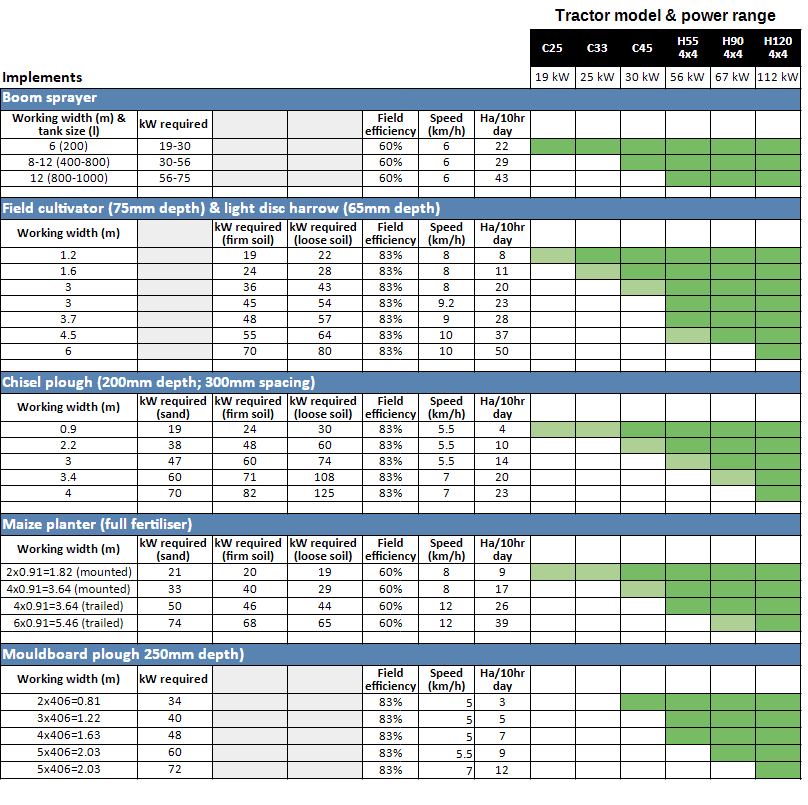
Field efficiency %: The field efficiency factor allows for time spent on turning on the headlands, refuelling the tractor, filling seed and fertiliser bins on a planter amongst others, and therefore it is measured as a decimal. In practice, if the field efficiency is one that would mean the tractor would work the whole 10-hour day without stopping or turning.
Field capacity: The field capacity is how many hectares a tractor can work on a 10-hour day. It is calculated as follow: speed in km/h x working width in metres x field efficiency.
Provision has also been made in the tables for different soils. In the table of field capacities, the column ‘kW required’ gives an indication of the actual power required to carry out the operation at a specified field capacity.
Note that in practice, depending on how efficiently the operations are carried out, actual values may differ from the figures in the tables below.
Sources:
1.Pietman Botha, Independent Agricultural Consultant; https://www.grainsa.co.za/do-your-homework-before-buying-a-tractor
2.Electric Tractor Implement Compatibility, Bridging today’s AgTech and workforce with that of the future: https://www.monarchtractor.com/electric-tractor